From the Chilliwack River to Climate Change: The Pristine Coast Story
In the fall of 2008, Scott Renyard was standing on the banks of the Chilliwack River watching ocean-fresh Coho salmon float by, belly up, dead. He had never seen anything like it. A week later, he saw a news story about biologist Alexandra Morton’s observations about fish farms and disease in the Broughton Archipelago, and he picked up the phone. That call launched a film that would take years to complete, lead to discoveries connecting fish farm diseases to the collapse of wild fish populations across two oceans, and end with a finding that stunned audiences at the Vancouver International Film Festival: that the loss of wild fish was not being caused by climate change, but was causing it. This is how Scott made The Pristine Coast, in his own words.
This article is the second part of our interview series with Scott Renyard, founder of The Green Channel.
Read the first part here: From Revelstoke to The Green Channel, Read the other parts here: 119 Inside the Courtroom, The Films of Scott Renyard.
Question: The Pristine Coast started as a film about fish farming’s impact on wild salmon, but you ended up uncovering something much broader. Can you walk us through that discovery?
After many years of raising a family, paying bills, and trying to make films while working full time, I began to lose weight. I was told by doctors that it was stress and that I needed to retool my life and have more down time. So, after my stint as a transportation captain on the series, The Outer Limits, I made plans to reduce my work hours and find a way to dedicate more time to creating my own films. So, I decided to buy a film truck rental company from a colleague who was retiring, so I would still have income, but not have to work grueling hours on the big film projects.
After this move, which was stressful to say the least, I decided to take up salmon fishing and found my way to a popular fishing hole an hour east of Vancouver called the Chilliwack River. The Chilliwack River has runs of all Pacific salmon species and Steelhead and is supported by a hatchery. One day in the fall, during the main Coho salmon run, I noticed a lot of silver, ocean-fresh salmon floating down the river belly up, dead. I had never seen anything like it in all the years fishing at that river, and my first instinct was that the sport fishermen were not handling the fish properly when releasing them.
On many B.C. rivers, wild fish have to be released, and only hatchery fish are available for retention. But, after stopping about 20 of the floating dead fish and taking a closer look, I noticed they were a mixture of hatchery (the adipose fin is clipped so a fisherman can tell which is a hatchery fish) and wild fish. It was very strange.
About a week later, I saw a story in the news about Alexandra Morton’s observations that the fish farms in the Broughton Archipelago were causing disease outbreaks in Chum and Pink salmon runs in her area. Morton had been reporting on this problem since 1989, but it was the first time I recall hearing about it. Since I had met her during the filming of “Who Killed Miracle?”, I decided to give her a call. On the call, I asked, “Do you think the diseases coming from the farms could be affecting salmon runs this far south and in the Fraser River system?” After a few moments, she replied that it was definitely possible because the salmon runs of the Fraser River system go right past these farms on their return to the Fraser River to spawn. I think at that moment we both realized the impact of the farms on wild salmon runs was likely much, much larger than anyone would have expected. At that moment, I realized that this was going to be my next film.
Even though I had been a sport fisherman for most of my life in freshwater lakes for trout, I realized I needed to know a lot more about salmon, how long the fish farms were around, and who were the major players. So, my first step was to undertake several months of research.
Luckily, one of the best finds was The Fisherman’s News archive, and I was given full access to all the old editions of the newspaper. This was invaluable in not only helping me to piece together the when and how our wild salmon populations crashed(which started in the late 1970s), but also what the community’s reaction was to the decline of our valuable wild salmon resources. The second treasure trove was Alexandra Morton’s own collection of materials, documents obtained through freedom of information requests, and the hundreds of letters she wrote to politicians and senior bureaucrats and their responses.
But films are not made out of research alone, I needed images. At that time, Alexandra’s work was gaining more and more attention in British Columbia. She discovered, with her lawyer Greg McDade, that the Provincial and Federal governments had made an error in an MOU arrangement that gave the Provincial Government regulatory jurisdiction over the aquaculture industry. The federal government should have maintained control of fisheries in the ocean, as required under section 91(12) of the Constitution Act, 1967, but the challenge by Alexandra and her lawyer reversed that MOU. The Supreme Court ruling became known as the Hinkson Decision, which returned jurisdiction over aquaculture to the Federal Government. This decision did not guarantee that open net fish farms would be closed. But what it did do was make clear as to which level of Government was now responsible for the damage that was being done to wild salmon populations. Gone was decades of indecision and two levels of government that seemed to be tiptoeing around each other over how to regulate the industry.
In order to keep up the pressure on the Federal Government, Alexandra and a few friends decided to take the issue to the public with a protest walk down Vancouver Island from her home at the North end of Vancouver Island to the parliament buildings in Victoria, BC, at the south end. They called it the “Get Out Migration”.
The protest was scheduled to begin April 23, 2010, and end two weeks later on May 8, 2010. I decided to film the protest, interview Alexandra, and visit Echo Bay, where her discovery about the fish farm impacts began her campaign to shut down the farms. The footage I gathered during this week and a half was enough to launch production of the film.
Unfortunately, I wasn’t able to follow the entire protest because I was working full time running my rental company. After all, I couldn’t neglect the source of funds that was allowing me to self finance the film.
As a side note, the traditional paths for financing films in Canada are difficult at best. I tried for years to fund my films by applying for grants, going to film markets, but I was not successful most of the time. I found it a demoralizing exercise seeking other people’s permission to make a film. I tell young filmmakers today, whatever you do, don’t wait for someone to give you permission to make your movie. Go out and make it, and if you can’t afford to make a feature length film, make a short. Just go make it. And as soon as it’s done, make the next one. Certainly what has contributed to the self financing model is the improvements in cameras and how footage is now digital. This has revolutionized the industry and made filmmaking more affordable and accessible to more up and coming filmmakers.
But back to the protest. So, at every opportunity, I would join the protest, mostly at the major Vancouver Island towns, and record as much of the protest and rallies, with the help of my cinematographer Mark Noda, as I could. We made 8 trips to Vancouver Island during the protest and gathered some key moments that ended up in the film. And at the Campbell River stop, I met the wonderfully talented Rich Hagensen, who sang, “The Get Out Migration Song”. I approached Rich and not only did he agree to let me use his song in the film, we teamed up and co-wrote the title song as well, The Pristine Coast Song.
During one of my visits to the protest, the protestors took a lunch break, near the famous “big rock” at Campbell River. Alexandra came over to me and showed me a photograph of a Pacific herring. The herring was bleeding from the creases of its fins, and had blood in its eye. Alexandra told me, whatever is happening to our salmon, it’s happening to our herring as well. I was in shock. As a scientist, I asked myself, “if this is affecting salmon and herring, how many other species of fish are being affected?” This was the first ah-ha moment for this project and it dramatically shifted my focus for the film.
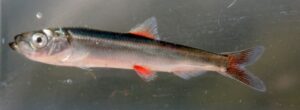
This photograph would become the feature image in the poster for the film.
Back at home, I began to dig around for evidence with this thought in mind. It wasn’t long before I found evidence that all salmon species were in trouble, so were the iconic steelhead populations, the magnificent Fraser River sturgeon, our prized groundfish, and many other marine fish populations. As far as I could tell, all fish with fins had been declining or crashing completely since the introduction of open net pen fish farms.
It’s hard to imagine after discovering this, that it could get worse. But it got worse. I came across a document in Alexandra’s collection, a paper published in 1987 and written by John D Neilson, R. Ian Perry, J.S.Scott, and P.Valerio entitled, “Interactions of caligid ectoparasites and juvenile gadids on Georges Bank”. Even though the authors were unsure of the cause of their findings, this paper was crucial evidence that sea lice population explosions coming from the open net pen fish farms were having the same effect on Canadian Atlantic fish populations. And this was the likely cause of vital commercial fish species collapses, including Atlantic salmon and the iconic Northern Cod. I suddenly realized that disease, and not overfishing, was not only causing a collapse of fish populations on both coasts, but probably the main cause behind wild fish population collapses right across the North Pacific and North Atlantic oceans. And there was plenty of evidence from countries like Japan on the Pacific side and European countries like Scotland and Norway on the Atlantic side.
As the film was coming together, the story was growing from a concern about wild salmon populations to alarm bells ringing in my head that all wild fish populations were in trouble from what I believed was out-of-control fish pandemics.
The federal government was also concerned and was feeling the public outrage over the lack of action to protect wild salmon populations. In particular, the crash, starting in 1992, of the Fraser River sockeye stocks, one of Canada’s most prized commercial fisheries. The data clearly showed the Fraser sockeye populations were going extinct and recruitment (the number of spawners that return to spawn from a pair of spawners) that was normally about three pairs or six fish had dropped to less than two fish. So, the federal government struck a commission of inquiry called “The Uncertain Future of Fraser River Sockeye,” also dubbed The Cohen Inquiry.
The hearings would go on to produce some of the most compelling moments in Canadian inquiry history, including the dramatic testimony of Kristi Miller and Alexandra Morton. But that is a story for another day.
Stream Award-Winning Environmental Films
Watch anywhere. Cancel anytime.
Then only CA$9.99/month


